
What Is NCDAC?
NCDAC is the current official abbreviation used for the North Carolina Department of Adult Correction. The agency's public site is branded "Adult Correction | NC DAC," and the research confirms that NCDAC is the safe current label for statewide page titles, headings, and inmate-search copy. The department became a standalone cabinet agency on January 1, 2023, after adult correction functions were separated from the Department of Public Safety structure.
NCDAC runs the state prison system and community supervision functions. It does not run county jails. That split is the most important search rule for North Carolina custody records. Someone arrested today may be in a county or regional jail roster even when no NCDAC record appears. Someone sentenced to a North Carolina prison, on probation, on parole, or on post-release supervision belongs in the NCDAC search path.
The NCDAC about page confirms the agency identity and current statewide Adult Correction framing.
That agency context helps separate the NCDAC inmate population from local jail custody, federal BOP custody, ICE detention, and court case records.
The NCDAC Inmate Population
The official prison population figure in the research is 31,932 people in custody on June 30, 2024, from NCDAC's FY 2023-2024 Annual Statistical Report. The same report says 99 percent of that population, or 31,472 people, was in felony-conviction custody, and 1 percent, or 460 people, was in misdemeanor-conviction custody. This is the state-prison population, not every person in a North Carolina county jail.
| Measure | Figure | Source |
|---|---|---|
| NCDAC inmate population | 31,932 | FY 2023-2024 report, June 30, 2024 |
| Felony-conviction custody | 31,472 | FY 2023-2024 report |
| Misdemeanor-conviction custody | 460 | FY 2023-2024 report |
| Named adult prison facilities on web list | 47 | NCDAC prison-facility list |
How to Search NCDAC
The official NCDAC inmate locator is the Offender Public Information Search, reached from the NCDAC criminal offender searches page or directly at the public search application. NCDAC describes the search as a name or offender ID search for state prison offenders, probationers, and parolees. The research notes current and historical information back to 1972, along with special tools for escapes and captures, absconders, releases, and bulk statistical downloads.
- Open the NCDAC offender-search landing page, then choose the Offender Public Information Search.
- Search by offender ID when known. It is the strongest match key.
- If no ID is known, search by last name and first name, then broaden spelling if needed.
- Review the result list for name, offender number, location, status, and identifying details.
- Open the public offender profile and compare custody status, location, sentence, and supervision fields.
- If the arrest is recent and no result appears, search the county jail first.
The NCDAC Offender Public Information Search is the locator form used for public state-prison and supervision lookups.
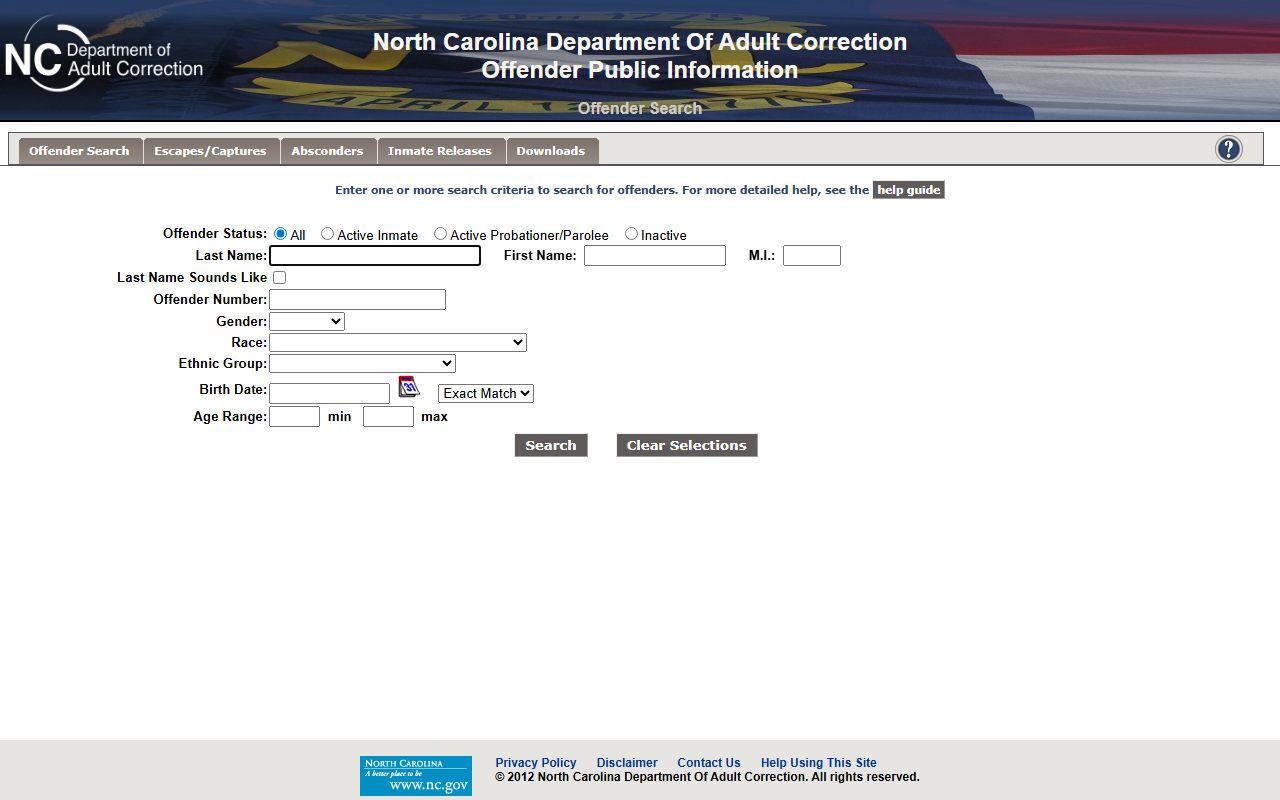
Use the result as a state custody record, not as a full criminal background check or a county jail booking report.
NCDAC Inmate Record Fields
NCDAC profile fields vary by custody status and history. The research identifies common public concepts such as offender number, legal or committed name, aliases, admission date, admitting location, current location, previous location, custody classification, control status, incarceration status, offense, primary crime, sentence type, punishment type, detainers, movement history, total incarceration term, supervision term, infractions, and review dates.
| Field | What It Means |
|---|---|
| Offender number | The strongest public search key for a North Carolina prison or supervision record. |
| Current location | The prison, supervision status, or public custody location shown by NCDAC. |
| Admission date | The public date tied to entry into the state correctional system. |
| Custody classification | The assigned risk and custody level, when shown on the public profile. |
| Sentence or offense fields | Public conviction and sentence information that NCDAC is allowed to release. |
| Detainer or movement data | Public notes that may explain agency holds or custody changes when available. |
Important: NCDAC says internal prison records, active-offender medical records, behavior records, classification records, and community-supervision records can be confidential.
NCDAC Custody Classification
The NCDAC classification page explains how new admissions move from county jails to prison receiving centers, then through evaluation and assignment. Classification staff assess medical and mental health needs, crime, social background, education, job skills, work history, health, criminal record, and prior prison sentences. Inmates can move through classifications as behavior and risk change.
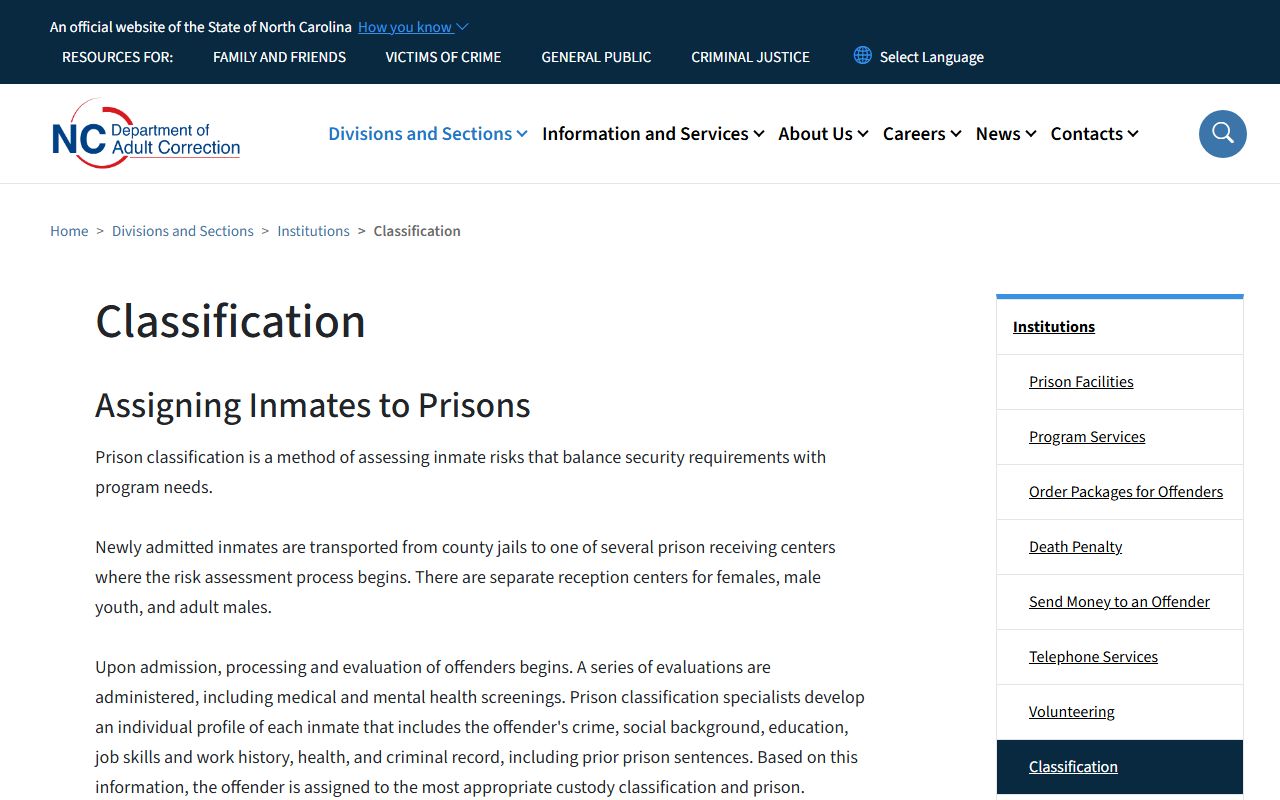
NCDAC custody levels include close, medium, minimum I, minimum II, and minimum III. Control statuses include restrictive housing for administrative, disciplinary, and control purposes, plus high-security maximum control.
- Close custody
- The highest listed custody risk level in the NCDAC public classification summary.
- Minimum III
- The lowest listed custody level in the NCDAC public classification summary.
- RHAP, RHDP, and RHCP
- Restrictive housing statuses for administrative, disciplinary, or control purposes.
- HCON
- High-security maximum control status.
NCDAC Prisons and Facilities
NCDAC's current adult prison facility list includes 47 named institutions, from Albemarle Correctional Institution through Wilkes Correctional Center. The FY 2023-2024 report uses a broader count of 56 prison facilities when state prisons, confinement in response to violation centers, contractual residential programming, and related adult correction categories are counted. The directory must be read with those category differences in mind.
Special missions matter in North Carolina. Central Prison in Raleigh is the main male medical and mental-health treatment center and houses special populations, including death row and safekeepers. North Carolina Correctional Institution for Women is the state's primary women's prison and houses all custody levels and control statuses. Craven Correctional Institution is a major processing center for convicted felons entering from county jails. The Butner facilities are not NCDAC prisons at all; they are federal BOP institutions.
The NCDAC prison-facility page lists the adult prison facilities and regional office structure.
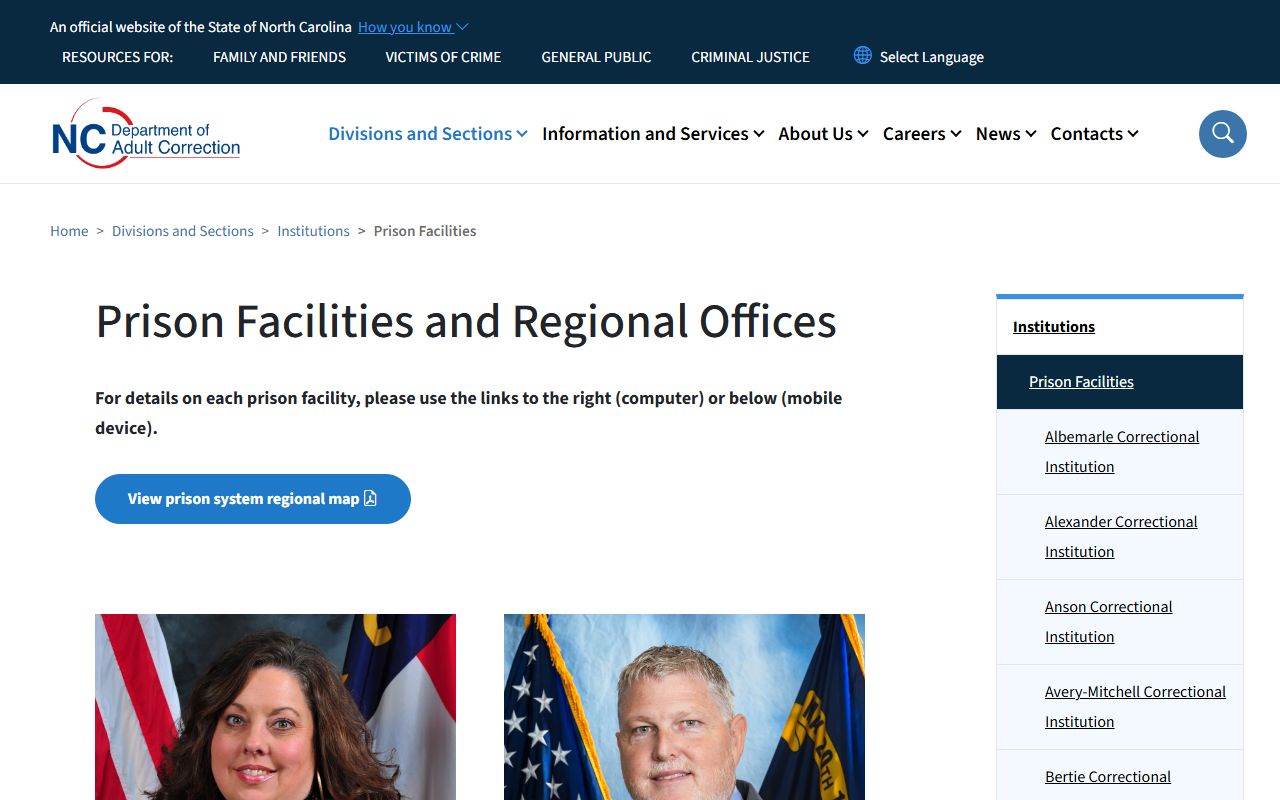
The statewide Facility Directory adds county jails, regional jails, federal facilities, and juvenile facility notes so each custody path stays in its own lane.
NCDAC Inmate Population Trends
The NCDAC inmate population rose in each of the three official year-end points in the research. It moved from 30,504 on June 30, 2022, to 31,197 on June 30, 2023, then to 31,932 on June 30, 2024. Research notes connect that movement to a rebound after COVID-era court disruptions, when court operations were suspended or changed and convictions decreased.
| Date | NCDAC Inmate Population | Change From Prior Listed Year |
|---|---|---|
| June 30, 2022 | 30,504 | Baseline in this research set |
| June 30, 2023 | 31,197 | Up 693 |
| June 30, 2024 | 31,932 | Up 735 |
The published annual-report figures should be paired with the live locator, records, and facility pages because population reports and individual custody records answer different questions.
NCDAC Sentencing and Release
North Carolina's modern prison release structure is based on Structured Sentencing and post-release supervision. NCDAC's parole-process page says discretionary parole, as it previously existed, was eliminated for crimes committed on or after October 1, 1994. It also says Structured Sentencing requires an offender to serve at least 100 percent of the minimum sentence and 85 percent of the maximum sentence. After required prison time, many felony offenders move to post-release supervision.
G.S. 15A-1340.13(d) says an active sentence must include service of the minimum term, except as otherwise provided, and that earned time may reduce the maximum term down to, but not below, the minimum term. This is why release dates should be read carefully. Earned time can affect the maximum portion and supervision timing, but it does not erase the minimum active term.
The NCDAC parole-process page explains Structured Sentencing, older parole-eligible categories, and post-release supervision.
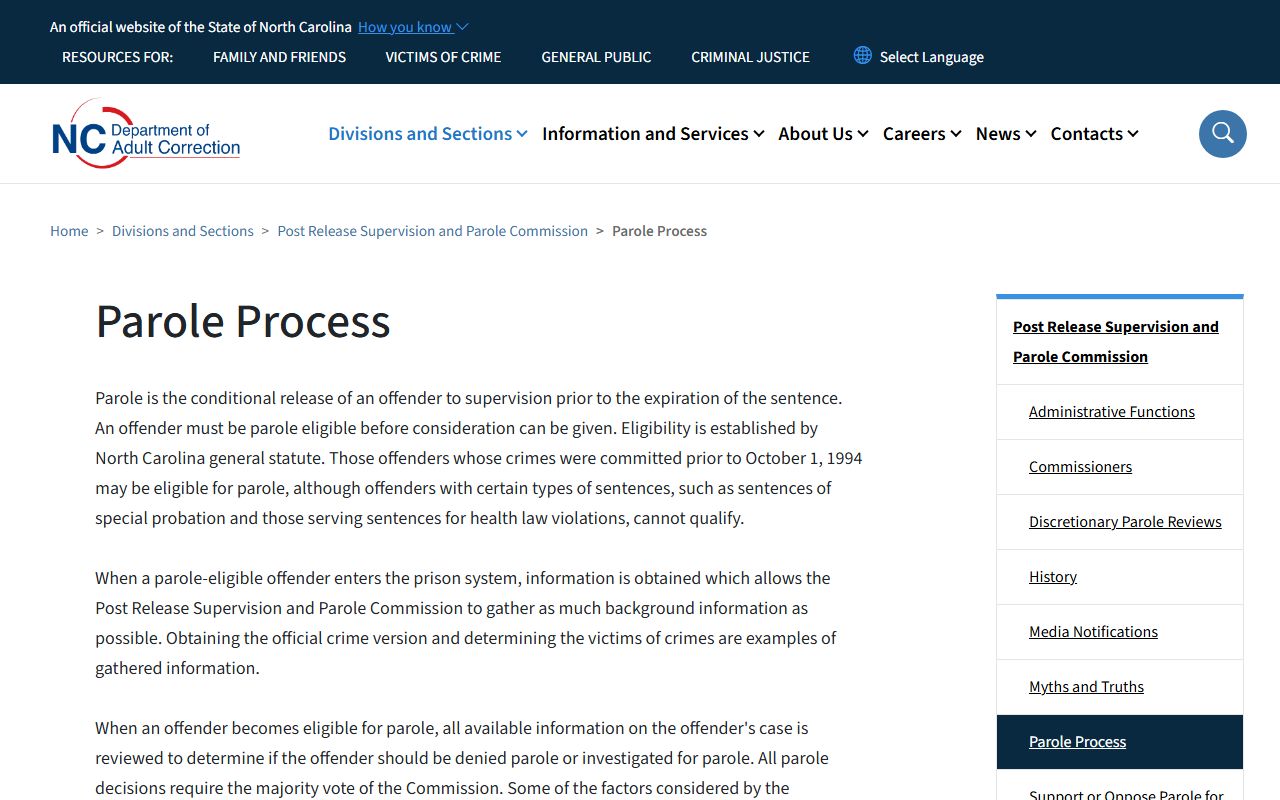
For current ordinary felony offenses after October 1, 1994, the key terms are structured sentencing, earned-time limits, and post-release supervision, not a traditional parole board release date.
NCDAC vs County Jail
The NCDAC inmate population is not the same as the county jail population. County jails hold pretrial detainees, people waiting for first appearance or bond, short local sentences, probation or parole holds, civil commitments where authorized, and people waiting for transfer. NCDAC becomes central after a state-prison sentence or when the person is under North Carolina probation, parole, or post-release supervision.
| Issue | NCDAC | County Jail |
|---|---|---|
| Custody type | State prison and community supervision | Recent arrest, pretrial custody, bond, short local sentence |
| Main search | Offender Public Information Search | County jail roster or sheriff records office |
| Records custodian | North Carolina Department of Adult Correction | The county sheriff, regional jail, or local authority |
| No-result meaning | May still be in a local jail, federal custody, ICE, or court process | May be in NCDAC, BOP, ICE, another county, or released |
NCDAC Records Requests
NCDAC's public-records page says the department maintains records only for people who served time in an NCDAC prison facility or who are part of North Carolina probation, parole, or community supervision. It also says NCDAC does not have access to records for local, county, or city jails or detention facilities. Search the online offender locator first when the request is about a state prisoner or supervisee.
- Search NCDAC online if the record concerns a state prisoner, probationer, parolee, or post-release supervisee.
- Use the NCDAC public-record request link when the record is not already online.
- Be specific about the person, date range, record type, and requested format.
- Complete the full form because NCDAC says incomplete forms can delay the response.
- Route local jail records, court records, police reports, vital records, and county records to the actual local custodian.
The NCDAC public-records online page lists online public resources for offender information, policies, SBI background checks, sex offender registry, and court routing.
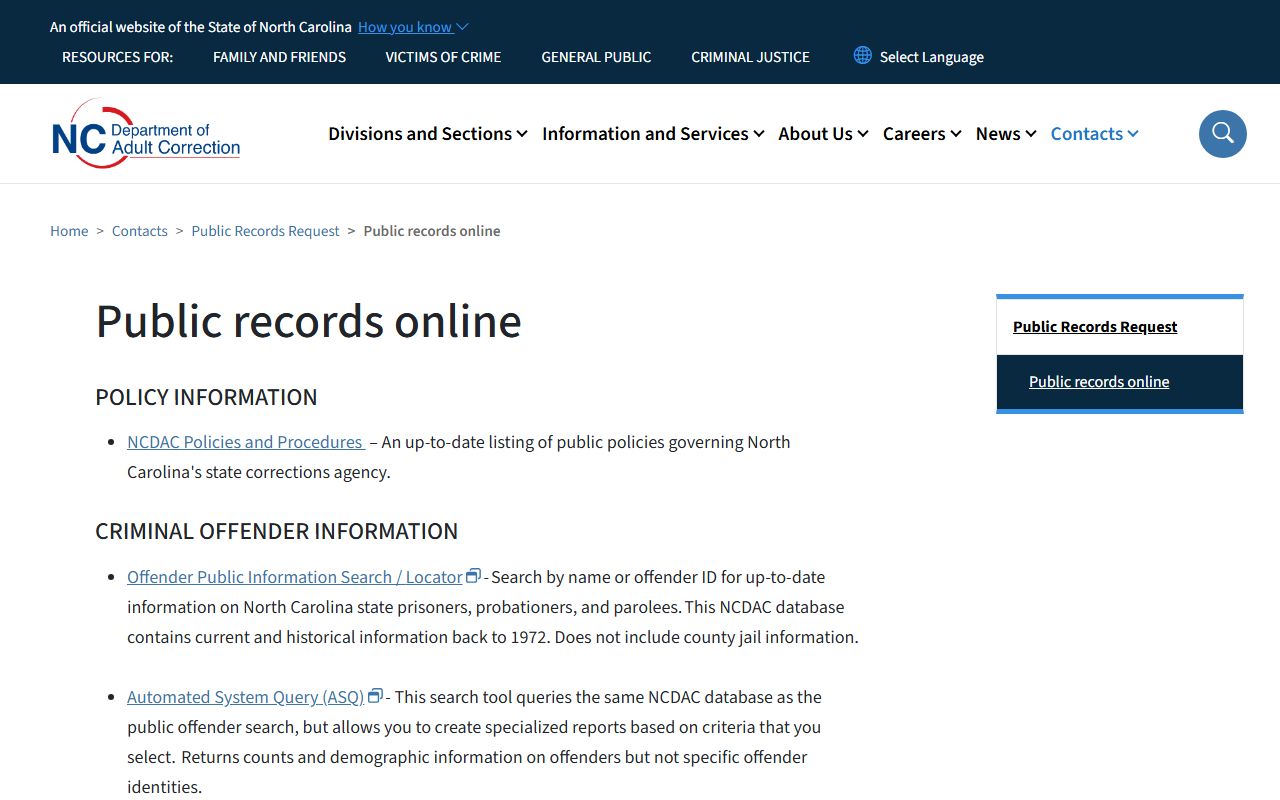
Use the correct custodian at the start, since sending a county jail request to NCDAC only adds delay.
NCDAC Inmate Population FAQ
What does NCDAC stand for?
NCDAC is the current abbreviation for the North Carolina Department of Adult Correction. The agency's public web pages also use NC DAC in branding. Use NCDAC for current statewide inmate population and inmate search pages.
How large is the NCDAC inmate population?
NCDAC reported 31,932 people in state prison on June 30, 2024. That number is from the FY 2023-2024 Annual Statistical Report and does not include everyone in a North Carolina county jail.
Why does an arrested person not appear in NCDAC?
A recent arrest usually starts in a county jail. NCDAC does not have local, county, or city jail records. Search the booking county through the County Directory before treating an NCDAC no-result as meaningful.
Is the NCDAC locator a background check?
No. NCDAC is a prison and supervision locator. The research says people needing background checks should use the North Carolina State Bureau of Investigation or court and clerk channels, depending on the record needed.